
Editorial Workflow
Educational Review: Research and Innovation (ERRI)
Editorial Workflow Statement
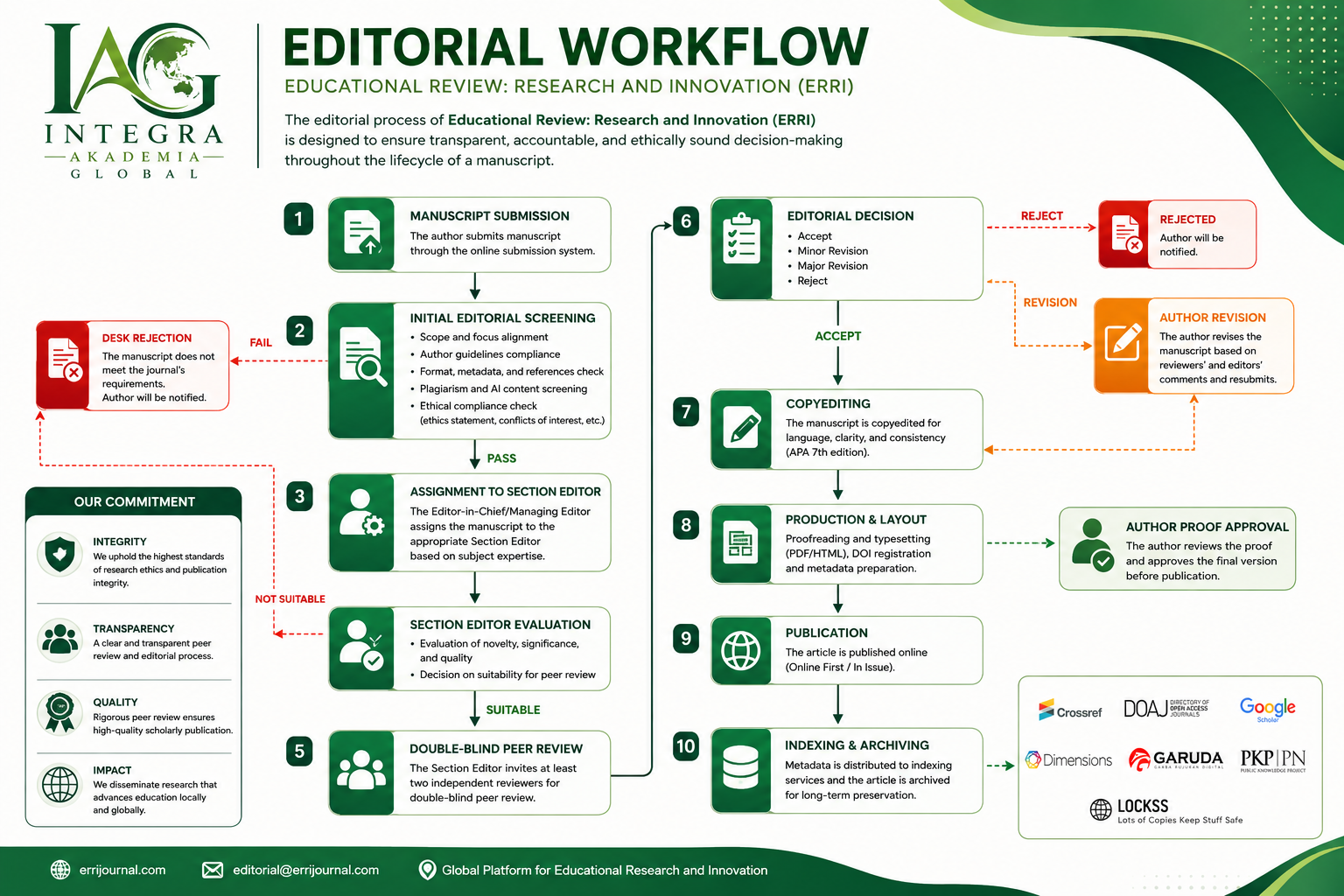
The editorial workflow of the Educational Review: Research and Innovation (ERRI) is designed to ensure transparency, academic integrity, efficiency, and compliance with international publication ethics throughout every stage of manuscript processing. All submissions undergo rigorous editorial screening, double-blind peer review, and quality assurance procedures before publication.
Editorial Workflow Policy
Educational Review: Research and Innovation (ERRI)
The editorial workflow of Educational Review: Research and Innovation (ERRI) is designed to ensure transparency, accountability, academic integrity, and compliance with international publication ethics throughout the manuscript lifecycle. Every submission is evaluated fairly through a rigorous editorial screening, double-blind peer review process, and quality assurance procedures before publication.
1. Submission Handling
All manuscripts must be submitted electronically through the Open Journal Systems (OJS) platform. Submissions sent by email or through any other communication channels will not be considered for publication.
| Requirement | Description |
|---|---|
| Submission System | Open Journal Systems (OJS) |
| Accepted Method | Online submission only |
| Not Accepted | Email submissions or other unofficial channels |
2. Initial Technical Screening
The Managing Editor performs an initial technical assessment to ensure that all submitted manuscripts comply with the journal's editorial requirements before entering the peer review process.
| Screening Criteria | Description |
|---|---|
| Author Guidelines Compliance | Verification of manuscript preparation according to ERRI Author Guidelines. |
| Submission Completeness | Confirmation that all required files and metadata have been submitted. |
| Formatting Review | Evaluation of manuscript structure, references, tables, and figures. |
| Similarity Screening | Plagiarism detection using recognized similarity-checking software. |
| Possible Outcomes | Return for technical revision or Desk Rejection. |
3. Scope and Academic Quality Assessment
The Editor-in-Chief evaluates whether the manuscript is appropriate for ERRI before assigning it to a Section Editor.
| Assessment Area | Description |
|---|---|
| Journal Scope | Alignment with ERRI's aims and scope. |
| Academic Quality | Minimum scholarly standards and originality. |
| Research Contribution | Potential contribution to educational research and innovation. |
| Outcome | Proceed to peer review or Desk Rejection. |
4. Editorial Assignment
Eligible manuscripts are assigned to an appropriate Section Editor according to subject expertise.
| Section Editor Responsibilities | Description |
|---|---|
| Peer Review Coordination | Selects qualified reviewers and manages the review process. |
| Communication | Communicates with authors and reviewers throughout the editorial process. |
| Recommendation | Provides editorial recommendations to the Editor-in-Chief. |
5. Editorial Decision-Making
Editorial decisions are based on scholarly merit, reviewer recommendations, methodological rigor, originality, and adherence to publication ethics.
| Decision Criteria | Description |
|---|---|
| Reviewer Reports | Recommendations from independent reviewers. |
| Scientific Merit | Originality and contribution to knowledge. |
| Methodological Quality | Research design and analytical rigor. |
| Publication Ethics | Compliance with ethical publishing standards. |
| Possible Decisions | Accept, Minor Revision, Major Revision, or Reject. |
The Editor-in-Chief retains full authority over all final editorial decisions.
6. Revision Management
Authors receiving revision requests are expected to submit a revised manuscript together with a detailed response to reviewers explaining how each comment has been addressed.
| Editorial Verification | Description |
|---|---|
| Reviewer Comments | Verification that all comments have been addressed. |
| Quality Improvement | Assessment of manuscript improvements. |
| Response Letter | Evaluation of author responses. |
| Possible Outcome | Further revision, acceptance, or rejection. |
7. Production Process
Accepted manuscripts proceed to professional production prior to publication.
| Production Stage | Description |
|---|---|
| Copyediting | Language editing and consistency according to journal style. |
| Proofreading | Final editorial quality check. |
| Layout Editing | Preparation of publication-ready PDF, HTML, and metadata. |
| Author Proof | Authors review and approve final proofs before publication. |
8. Publication
Following final approval, articles are published online as open-access publications.
| Publication Activity | Description |
|---|---|
| DOI Registration | Digital Object Identifier assigned through Crossref. |
| Open Access | Immediate online availability without subscription barriers. |
| Indexing & Archiving | Metadata distribution and long-term digital preservation. |
9. Editorial Responsibilities
Editors are expected to maintain the highest standards of editorial professionalism and publication ethics.
- Maintain confidentiality throughout the editorial process.
- Ensure fair, objective, and unbiased manuscript evaluation.
- Manage conflicts of interest appropriately.
- Uphold international publication ethics and research integrity.
- Never use unpublished materials for personal research or benefit.
- Never discriminate against authors based on nationality, gender, institutional affiliation, religion, or political beliefs.
10. Conflict of Interest Management
Editors shall recuse themselves from handling manuscripts whenever a conflict of interest exists, including but not limited to:
- Institutional affiliation.
- Personal or family relationships.
- Research collaboration.
- Financial or professional interests.
In such circumstances, responsibility for editorial handling will be assigned to another qualified editor.
11. Ethical Oversight
ERRI follows the Committee on Publication Ethics (COPE) Core Practices in managing ethical issues throughout the publication process.
- Handling complaints and appeals.
- Investigating allegations of research misconduct.
- Managing plagiarism and duplicate publication.
- Issuing corrections, retractions, and expressions of concern when appropriate.
12. Transparency and Accountability
All editorial activities are documented within the Open Journal Systems (OJS) platform to ensure transparency, accountability, and traceability throughout the editorial process.
| Principle | Description |
|---|---|
| Traceability | Complete documentation of editorial actions. |
| Accountability | Editorial decisions remain auditable and verifiable. |
| Transparency | Clear documentation of manuscript handling from submission to publication. |
Educational Review: Research and Innovation (ERRI)
Committed to Excellence, Integrity, and Innovation in Educational Research.